WiFi Pineapple Pager Hardware Documentation
Version: 1.0
Device Class: Portable Penetration Testing Platform
Manufacturer: Hak5 (Hardware Partner: GL.iNet / SinoVoip ecosystem)
1. Executive Summary
The WiFi Pineapple Pager is a highly portable, tactical wireless auditing device designed for 802.11 wireless assessments. It utilizes a heterogeneous multi-chip architecture, combining a low-power MIPS-based SoC for system management with a high-performance MediaTek chipset for advanced WiFi 6/6E attacks.
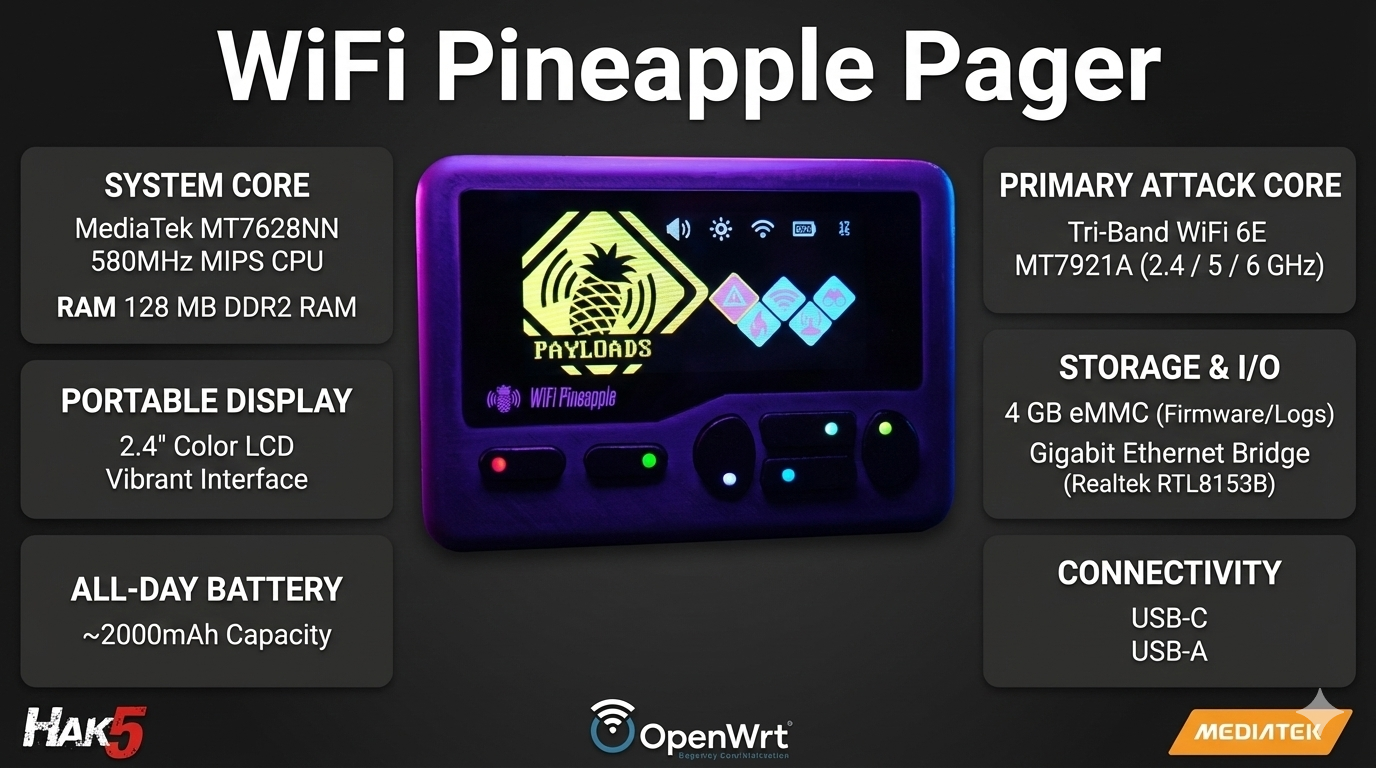
2. Hardware Specifications
| Component | Specification | Description |
|---|---|---|
| SoC (System on Chip) | MediaTek MT7628NN/AN | 580 MHz MIPS 24K CPU (Low Power) |
| Primary WiFi Chip | MediaTek MT7921AU | WiFi 6 (802.11ax) + WiFi 6E (6 GHz) |
| Management WiFi | Integrated in SoC | 2.4 GHz 802.11n (Legacy/Management) |
| Ethernet Controller | Realtek RTL8153B | USB 3.0 to Gigabit Ethernet Bridge |
| Storage (Main) | Samsung eMMC (KLM4G1FETE) | 4 GB Non-Volatile Storage (Firmware/Logs) |
| Storage (Boot) | SPI NOR Flash | ~16 MB - 32 MB (Bootloader/Recovery) |
| RAM | Integrated | 128 MB / 256 MB DDR2 (Embedded in MT7628) |
| Real-Time Clock | NXP PCF8563 | I2C RTC for timekeeping offline |
| Battery | Li-Ion Polymer | 2000 mAh (Estimated) |
| Display | TFT Color LCD | ~2.4 inch Screen |
3. Wireless Interface Breakdown
The device features a "Tri-Band" capability distributed across two physical radio chips.
Radio 0: Management & Legacy (wlan0)
-
Chip: MediaTek MT7628 (Integrated)
-
Standard: 802.11 b/g/n (WiFi 4)
-
Frequency: 2.4 GHz
-
MIMO: 2x2:2
-
Throughput: Up to 300 Mbps
-
Primary Role:
-
Hosting the Management AP (web interface).
-
Background scanning on 2.4 GHz.
-
Client mode connectivity (connecting to a hotspot for updates).
Radio 1: Attack & Auditing (wlan1)
-
Chip: MediaTek MT7921
-
Standard: 802.11 ax (WiFi 6 / WiFi 6E)
-
Frequencies:
-
2.4 GHz: Legacy coverage.
-
5 GHz: Modern standard coverage.
-
6 GHz: WiFi 6E extended spectrum.
-
Capabilities:
-
Packet Injection / Monitor Mode.
-
Frame capture (PCAP) on all supported bands.
-
Replay attacks, Deauthentication, Beacon flooding.
-
OFDMA & MU-MIMO: Supported for advanced auditing.
4. Component Deep Dive & Thermal Profile
A. MediaTek MT7921 (The "Attack" Core)
-
TDP (Thermal Design Power): ~2.5W (Peak Load)
-
Interface: USB 3.0 / PCIe (Internal)
-
Thermal Note: This is the primary heat generator. Under 100% load (e.g., continuous 6GHz deauth attacks), this chip can exceed 100°C if uncooled.
-
Location: Under the large top EMI shield (28mm x 32mm).
B. MediaTek MT7628NN (The "Brain")
-
TDP: ~1.7W
-
Architecture: MIPS 24KEc
-
Thermal Note: Generally runs warm. Throttling typically begins >90°C.
-
Location: Under the bottom/center EMI shield.
C. Realtek RTL8153B (Ethernet Bridge)
-
TDP: ~0.5W - 1.0W
-
Role: Provides high-speed network masquerading over the USB-C port. Allows the device to appear as a Gigabit Ethernet adapter to a host PC (USB Tethering/Gadget Mode).
-
Location: Near the USB-C port (Top Left/Center).
5. Input / Output & Connectivity
-
USB-C Port:
-
Power Input: 5V / 2A (Recommended).
-
Data: USB 2.0 / 3.0 Data + Serial Console (UART) access.
-
Networking: CDC-ECM / RNDIS (Ethernet over USB).
-
USB-A Port (Host):
-
Allows connection of external peripherals (GPS dongles, extra WiFi adapters, LTE modems).
-
Side Buttons:
-
Physical navigation (Up, Down, Enter) for headless operation via the screen.
6. Recommended Thermal Modification (For 100% Load)
Due to the compact chassis and high-performance chips, passive cooling is recommended for sustained operations.
Configuration: Independent Passive Heatsinks (Safety-Focused)
| Target Chip | Heatsink Type | Size | Notes |
|---|---|---|---|
| MT7921 (WiFi 6) | Copper Shim | 12 x 10 x 1.5mm | Critical. Requires Kapton tape insulation around chip. |
| MT7628 (SoC) | Copper Shim | 12 x 12 x 1.5mm | Improves system responsiveness. |
| RTL8153 (Eth) | Ceramic / Alu | 9 x 9 x 2.0mm | Optional. Prevents bottlenecking during large PCAP transfers. |
| Samsung eMMC | Ceramic | 12 x 12 x 2.0mm | Optional. Extends flash storage lifespan. |
Installation Requirement:
-
Thermal Tape: 3M 8810 or equivalent (Double-sided).
-
Insulation: Kapton (Polyimide) tape on surrounding capacitors to prevent shorts from copper shims.
7. ui improvements
ui improvements look at different branches like the iPod branch for different styles